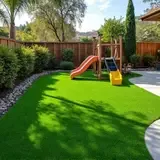
Playground turf in Boise is published as a safety surface before it is a lawn. The published surface is ASTM F1292 fall-rated and protects up to a 10-foot fall height, made of non-toxic material with no lead and no heavy metals, on a stay-cool fiber that reflects heat in full-sun conditions, and ADA accessible as a wheelchair-friendly surface. The published market bands are the same as any turf work - 8 to 15 per square foot installed, or 5 to 15 for a complete professional installation including removal, excavation, a crushed-rock base, turf and infill - because the source material publishes market-wide turf bands rather than a separate playground rate, and a play surface is specified and tested differently from a lawn. Published drainage is 30+ inches per hour, the base is open-graded stone compacted to 95% Standard Proctor, and a finished surface is published at 15-20 years with proper maintenance. Boise Artificial Turf Pros is a free matching service, not a provider: we route your request to licensed local installers, we do not employ contractors, and we do not sell playground turf services.
What it costs in Caldwell
| Job | Published 2026 range |
|---|---|
| Removal of the existing lawn and debris hauling, added to the installation | 1 - 3 per square foot |
| Excavation and a compacted crushed-rock base, added to the installation | 1 - 3 per square foot |
| Class II road base aggregate | $40 per ton |
| No. 57 clean washed angular stone | $48 per ton |
| Non-woven geotextile soil separator placed under the base | $0.45 per square foot |
| Basic turf with silica sand infill, per square foot installed | $4.00 per square foot |
| Rapid-drain turf with zeolite infill, per square foot installed | $6.00 per square foot |
| Standard installation labour | $5.50 per square foot |
| Pet-spec installation labour, deeper dig and edge pinning | $6.50 per square foot |
| Permit allowance, where the jurisdiction requires one | 100 - 500 |
| Spot repairs and small fixes | a few hundred to several thousand depending on scope |
What a playground turf installation actually involves
A play surface is specified around impact, not appearance, and the published description of the surface is short and specific: ASTM F1292 fall-rated, protecting up to a 10-foot fall height; non-toxic, with no lead and no heavy metals; stay-cool technology that reflects heat in full-sun conditions; and ADA accessible as a wheelchair-friendly surface. Everything underneath is published as being in service of those four properties.
| Element | Published description | What it decides |
|---|---|---|
| Infill | Infill spread between the blades at the manufacturer's published rate | Impact attenuation, and how the fiber stands up under play traffic |
| Turf surface | ASTM F1292 fall-rated surface, protecting up to a 10-foot fall height | The fall height the surface can be used under |
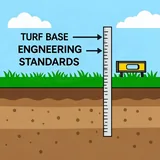
| Base | Open-graded angular stone, #57 or CA7, compacted in 2-inch lifts to 95% Standard Proctor | Uniform impact response; a soft spot is a fall risk, not just a wrinkle |
| Separator | Non-woven geotextile under the stone | Keeps native soil out of the drainage |
| Access route | ADA accessible, wheelchair-friendly surface | Whether the play area can be reached and used at all |
The published point about the base is that impact attenuation is a property of the whole build, not the carpet: an under-compacted or under-depth base produces exactly the soft spots the published diagnostic table warns about on any turf job, and on a play surface those spots are where the rating stops holding.
The published cost bands and how a play surface is quoted
The source material publishes market-wide turf bands rather than a playground-specific rate, and that is worth knowing before you compare quotes, because it means a playground number has to be built from the same published components as any other turf job.
| Scope | Published band |
|---|---|
| Complete professional installation, per square foot | 5 to 15 |
| Installed artificial turf in this market, per square foot | 8 to 15 |
| Removing an existing lawn and hauling debris, per square foot | 1 to 3 |
| Excavation plus a compacted crushed-rock base, per square foot | 1 to 3 |
| Basic turf material, per square foot | 2 to 4 |
| Premium high-face-weight turf material, per square foot | 4 to 8 |
| Typical 500-square-foot area, whole job | 4,000 - 7,500 |
| Whole-project band published for the market | 15,000 and 35,000 |
Three published cautions apply when a playground is quoted from these bands. The two published shapes disagree - a 500-square-foot area at 8 to 15 per square foot does not land near the 15,000 to 35,000 whole-project band - so ask which applies to your scope. A play surface uses premium high-face-weight fiber rather than the basic 2 to 4 material, which puts it at the upper end of the material line. And the published permit costs for this niche run 100-500, which a school, park or association project can add on top of a residential-shaped quote.
Why the Treasure Valley is hard on a play surface
Two published conditions decide whether a play surface is usable rather than merely installed. The first is heat, and it is the sharper one for children: published surface temperatures reach 150 to 180 degrees in full sun, and the source material describes surface temperatures climbing past 140 degrees in full sun. The published mitigation is stay-cool fiber technology, which reflects UV and heat, plus water - on the hottest days a 30-second rinse with a garden hose is published as dropping the surface below the 110-degree threshold the source material uses for bare feet and paws.
The second is water. Boise is a cold-winter, hot-dry-summer valley market, and the case for artificial turf here inverts the desert-water argument used in the Southwest. The NOAA/NCEI 1991-2020 monthly normals for Boise Air Terminal (USW00024131, the station USDA uses for this valley) put January normal average at 32.2 F with a normal daily minimum of 25.5 F and a normal daily maximum of 38.8 F, July normal average at 77.3 F with a normal daily maximum of 92.7 F, annual precipitation at 11.51 inches, and the annual snowfall normal at 17.6 inches (https://www.ncei.noaa.gov/data/normals-monthly/1991-2020/access/USW00024131.csv, HTTP 200). The 2023 USDA Plant Hardiness Zone Map places Boise in zone 7a, i.e. an average annual extreme minimum of 0 to 5 F (map at https://planthardiness.ars.usda.gov/, HTTP 200; ZIP 83702 lookup returns 7a, https://phzmapi.org/83702.json, HTTP 200). Computed from the NOAA ACIS daily record for the same station over 1991-2025 (https://data.rcc-acis.org/StnData, HTTP 200), the median last spring freeze at or below 32 F falls on about May 1, the median first fall freeze on about October 18 - a frost-free window of roughly 170 days - and the station averages about 108 days a year with a minimum at or below 32 F. City of Boise design criteria state Boise's frost depth is 24 inches minimum below grade (https://www.cityofboise.org/departments/planning-and-development-services/building/homeowners-guide/, HTTP 200). Two consequences drive the whole market: for roughly a third of the year the lawn is dormant, muddy and physically unwalkable (a dog-run and back-door problem long before it is a water problem), and the ground itself moves through the freeze-thaw cycle on a scale of a hundred-plus freezing nights. Summer is the opposite - hot, dry and windy enough that keeping a real lawn green is a six-month irrigation project: Veolia's regional president puts service-area demand at 'above 90 million gallons a day' in summer against '25 million gallons during winter' (https://www.cityofboise.org/news/public-works/2026/july/city-of-boise-adopts-drought-ordinance, HTTP 200). A play area is a large, flat, hard-used surface with the stone base carrying the load, and the published specification for a high-use commercial-style surface is drainage of 30+ inches per hour, which is what keeps a surface usable after the heaviest rain of the season rather than closed for a day. The Treasure Valley floor is not the caliche of the Southwest but it hardpans just as decisively, and at worse depths. USDA-NRCS Soil Data Access samples across the seven towns return loess-and-volcanic-ash-derived Argidurids and Calciargids with silica-lime duripans, plus thick calcic horizons. Purdam, the mapping at the Meridian town centre, is a fine-silty, mixed, superactive, mesic Haploxeralfic Argidurids whose typical pedon carries a strongly cemented duripan from 24 to 38 inches, with depth to duripan ranging 20 to 40 inches and depth to calcium carbonate 12 to 28 inches (https://soilseries.sc.egov.usda.gov/OSD_Docs/P/PURDAM.html, HTTP 200); Purdam's type location is Canyon County about 4 miles southwest of Caldwell. Elijah, mapped across south Boise, is a fine-silty Xeric Argidurids with a continuous, very strongly cemented platy duripan in the typical pedon and a range of 20 to 40 inches to the pan (https://soilseries.sc.egov.usda.gov/OSD_Docs/E/ELIJAH.html, HTTP 200). Colthorp, the mapping at Kuna, is a loamy, shallow Xeric Argidurids with an indurated duripan at 10 to 20 inches and fractured basalt bedrock at 20 to 40 inches - in the typical pedon, duripan 19 to 28 inches and lithic contact at 28 inches (https://soilseries.sc.egov.usda.gov/OSD_Docs/C/COLTHORP.html, HTTP 200); its type location is in Ada County. Against those are the wet, lime-rich soils of Canyon County: Bram, mapped at Caldwell and typed in Canyon County about 2 miles southeast of Caldwell, is a coarse-silty Xeric Haplocalcids that is somewhat poorly drained with a fluctuating water table at 3 to 6 feet for a few months or longer, a calcic horizon from 17 to 32 inches, and subhorizons that are slightly to strongly saline or saline-alkali (https://soilseries.sc.egov.usda.gov/OSD_Docs/B/BRAM.html, HTTP 200). Paulmyers, mapped in north Meridian, is a fine-loamy Aquic Calciargids with a fluctuating water table at 30 to 40 inches from June to August that the series description explicitly says is induced from irrigation (https://soilseries.sc.egov.usda.gov/OSD_Docs/P/PAULMYERS.html, HTTP 200). The Foothills and the southeast benches are the third zone: the Aldape-Dangulch-Castlerock complex on 8 to 35 percent slopes is fine, smectitic and shrink-swell (Aridic Palexerolls, Calcic Argixerolls, Torrertic Argixerolls), and further up-slope the Hullsgulch-Quailridge-Cranegulch complex is fine-loamy to fine, mesic Aridic Argixerolls on 5 to 65 percent slopes (https://soilseries.sc.egov.usda.gov/OSD_Docs/H/HULLSGULCH.html and https://soilseries.sc.egov.usda.gov/OSD_Docs/Q/QUAILRIDGE.html, both HTTP 200). For an artificial turf build that means three things: base excavation and edge restraint can hit a cemented or indurated duripan at 10 to 40 inches, so final depth is whatever the pan allows, not whatever the spec says; in Canyon County the same excavation meets a seasonally high water table and saline-lime subsoil, where drainage, base course selection and what happens to the grade line under freeze-thaw matter more than the topsoil; and on the foothill smectitic clays the native soil shrinks and swells with moisture, so subgrade preparation and edge detail are the failure points. Urban land is the mapped unit over much of built-up Boise and west Boise, so verify the actual lot with USDA-NRCS Web Soil Survey before finalising base depth (https://websoilsurvey.nrcs.usda.gov/app/).
UV is the third published factor, and it is why the recommended turf is UV-resistant so it does not fade or degrade over time - a play surface takes that exposure across the whole area rather than in patches, and stay-cool fiber is the published technology for it.
Local note for Caldwell
Caldwell's sampled mapping is the Bram series, and it is the wettest, most lime-charged profile in this market: Bram is a coarse-silty, mixed, superactive, mesic Xeric Haplocalcids that is somewhat poorly drained with moderately slow permeability, a fluctuating water table at 3 to 6 feet for a few months or longer, a calcic horizon from 17 to 32 inches, and subhorizons that are slightly to strongly saline or saline-alkali (https://soilseries.sc.egov.usda.gov/OSD_Docs/B/BRAM.html, HTTP 200). Bram's type location is Canyon County, about 2 miles southeast of Caldwell near Indian Creek at about 2,415 feet elevation (same source). The Purdam series' type location is also in Canyon County, about 4 miles southwest of Caldwell, and Purdam carries a strongly cemented duripan in the 20-to-40-inch range (https://soilseries.sc.egov.usda.gov/OSD_Docs/P/PURDAM.html, HTTP 200), so within one city a base excavation can either meet a shallow hardpan or sit above a shallow seasonally high water table - grading, drainage and base course have to be resolved per lot.
Caldwell's Water Department page lists the utilities department phone as (208) 455-3000 option 1, an after-business-hours emergency line of (208) 250-1638, email [email protected], business hours Monday-Friday 8:00 a.m. to 5:00 p.m., the Water Utilities Department at City Hall, 205 S. 6th Ave, Caldwell ID 83605, and the Water Department shop at 305 W. Chicago St. (https://www.cityofcaldwell.org/Departments/Water - HTTP 403 to our datacentre IP, i.e. bot protection on the correct city source rather than a broken link; the live page and these numbers were retrieved and verified through a rendering fetch on the same URL). The page makes clear that water and irrigation are separate accounts billed separately, and that irrigation questions including billing go to (208) 455-3070 option 2 (same source). The department's published documents include an annual water quality report, a city water regulations/ordinance document, a hydrant meter use policy, and an application form for City Water for Irrigation Purposes (same source) - the last is the form a landscape or turf irrigation customer would need if the property is not on a district system.
Utility accounts: City of Caldwell Water Utilities Department · 208-455-3000 (option 1)
Checking a quote in Caldwell
- How deep will you excavate, and is that depth stated in the contract with the aggregate type?
- Which base material is specified - open-graded washed angular stone, or a dense-graded road base - and where does it come from?
- What compaction target do you build to, and how do you verify it before the turf goes down?
- Where will the drainage slope run on my lot, and how does water and dog urine leave the surface?
- Is the removal of the old lawn, the sprinkler capping and the debris disposal inside the quote or billed separately?
- What infill are you using, how many pounds per square foot, and is the seam and workmanship warranty separate from the turf manufacturer's warranty?
Frequently asked questions
How much does playground turf cost in Boise?
The source material publishes market-wide turf bands rather than a separate playground rate: 8 to 15 per square foot installed, or 5 to 15 per square foot for a complete professional installation including removal, excavation, base, turf and infill, with removal and hauling at 1 to 3 per square foot, excavation plus a compacted base at another 1 to 3, and turf material at 2 to 4 per square foot for basic fiber or 4 to 8 for premium high-face-weight fiber. A play surface uses the premium end, and published permit costs for this niche run 100-500. Get three quotes with an identical base scope.
What fall height is playground turf rated for?
The published playground turf in this niche is ASTM F1292 fall-rated and protects up to a 10-foot fall height. ASTM F1292 is the standard specification for impact attenuation of surfacing materials within the use zone of playground equipment, and it establishes a critical fall height for a surface. Ask for the rating in writing for the system proposed - turf, infill and base together - because the base and the infill are published as part of what attenuates impact, not just the surface fiber.
How hot does playground turf get in the sun?
Published surface temperatures reach 150 to 180 degrees in full sun, and the source material describes surface temperatures climbing past 140 degrees in full sun. The published mitigation is stay-cool fiber technology that reflects heat and UV, plus water: on the hottest days a 30-second rinse with a garden hose is published as dropping the surface below the 110-degree threshold the source material uses for bare feet and paws.