The published lifespan of a properly installed artificial lawn is 15-20 years with proper maintenance, and many last even longer. That number hides the real question: not how long the grass lasts, but which part of the system is failing. A lifting seam, a faded patch and a sinking hollow look like one problem and have three different answers, because only one is a turf problem. The repair-or-replace decision is a question about the layer underneath.
The Lifespan Numbers, and Who Warrants What
The system. Most projects last 15-20 years with proper maintenance, and many last even longer. The published cost comparison assumes an 8 to 15 year lifespan when it balances the upfront installation against decades of watering and mowing.
The warranty. Manufacturers typically warrant the material 8 to 15 years against fading and fibre breakdown, while the installer warrants workmanship for 1 to 5 years. Some products advertise a 15-year fade warranty.
What Ages a Turf Lawn
Four processes account for almost all of the ageing:
- UV fading. UV exposure fades the turf; UV-resistant products resist it, which is what the fade warranty covers.
- Infill compaction and matting. Heavy traffic compacts the infill and flattens the fibres, leaving shiny flattened paths.
- Seams and edges. Lifting seams and curling edges are installation issues: inadequate adhesive or base preparation, not age.
- Thin product and thin infill. Low face weight, too little infill and no brushing are the published causes of a lawn that looks matted.
The first two are maintenance items, not end-of-life events: brushing keeps the blades upright and infill is topped up every year or two.
The Three Repair Tiers
Published guidance sorts turf problems by severity:
| Tier | What it covers | Typical scale |
|---|---|---|
| Minor | Sealing or resurfacing — localised surface fixes | Small repairs can start at a few hundred dollars |
| Moderate | Section replacement or levelling where one area has failed | Above the minor tier, priced by the section |
| Severe structural | Full replacement with proper site preparation | Major fixes may run into several thousand |
The tiers are about how much of the layer stack has to be opened up: sealing and resurfacing touch the top layer only, and section replacement lifts a defined area.
When Repair Stops Being the Smart Money
The line is the base: if the drainage layer failed, no surface repair will hold — the new section is laid onto the same problem. Three symptoms point down rather than up.
Sinking and spongy hollows. A surface that dips where it used to be flat sits on a base that was too thin or never compacted.
Water in the same place after every storm. Pooling that returns to one spot points to a dense-graded base, a weed barrier in the wrong position or a missing slope.
Odour that returns after a full saturation routine. When a 24 to 48 hour microbe saturation routine fails to clear the smell, the waste is in the base.
The Symptom Table
| What you see | Likely cause | The call |
|---|---|---|
| A wrinkled or lifting seam | Inadequate adhesive or trapped moisture | Repair — re-join and re-pin |
| A curling edge along the border | Edging or pinning failure | Repair with proper edging |
| Spongy hollows and a sinking surface | Base too thin or never compacted | Replace — the base has to be rebuilt |
| Water pooling in one spot after rain | Dense-graded base, or fabric in the wrong position | Replace — drainage has to be re-engineered |
| Odour that survives a 24 to 48 hour saturation routine | Waste trapped in the base, not the fibres | Replace — the fault is below the surface |
What Replacement Actually Involves
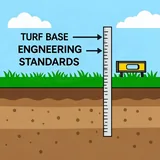
Replacement is not the same job as installation: severe structural issues typically need full replacement with proper site preparation. In practice the surface comes up, the failed layer comes out, and the stack is rebuilt — excavation to a minimum 4-inch depth for heavy use, open-graded washed angular stone compacted in damp 2-inch lifts to 95% Standard Proctor density, a non-woven geotextile at the bottom of the excavation, a one to two percent fall away from structures, and the base finishing 1.5 inches below the top of the edging.
Replacement is the moment to fix whatever caused the original failure — in the published failure modes nearly always a drainage detail — a dense-graded aggregate, a weed barrier in the wrong position, or a base never compacted to standard.
Most turf projects run two to six weeks from signing to completion; a full rebuild is at the longer end.
Where a Match Comes In
Diagnosis is the part worth attention in Boise, ID, because the same symptom can be sold two ways. This site is an independent matching service, not a provider: we do not employ contractors, sell turf or build, inspect or guarantee the work.
The service is free. Describe the lawn, its age and what it is doing, receive up to 3 matches from id-licensed local pros within one business day, and ask each: which layer has failed, and what is the cheapest fix for that layer? No commissions, no markup, no obligation.
Frequently asked questions
How long does artificial turf last?
Most projects last 15-20 years with proper maintenance, and many last even longer. Manufacturers typically warrant the material 8 to 15 years against fading and fibre breakdown, and the installer warrants workmanship for 1 to 5 years.
When should turf be repaired instead of replaced?
When the fault is in the surface or at an edge: lifting seams, curling borders, flattened paths and thin infill are repair work, and small repairs can start at a few hundred dollars. Replacement is the answer when the base has failed.
What are the warning signs that the base has failed?
A surface that sinks into spongy hollows, water pooling in the same spot after every storm, and an odour that survives a full 24 to 48 hour saturation routine. Each means the layer under the turf has to be rebuilt.
What should I do about a faded lawn?
Fading is cosmetic if the base is sound and the fibres are intact. Check the fade warranty term first — some products carry a 15-year fade warranty — and keep the infill topped up.
Sources
- Boise Artificial Turf Pros — artificial turf FAQ (published lifespan, project timeline and warranty bands)
- Boise Artificial Turf Pros — artificial turf problems: fading and infill compaction
- Boise Artificial Turf Pros — turf knowledge quiz (warranty split, maintenance and product quality answers)
- Boise Artificial Turf Pros — artificial turf problems: seams and edges lifting
Related
Artificial Turf services in Boise
Boise Artificial Turf Residential Turf
A residential turf installation is a drainage and sub-base project that ends in a lawn, and the published numbers only make sense once you know which of the two you are paying for.

Boise Artificial Turf Pet Turf
Pet turf is judged by what happens underneath it, not by how the blades look, and the published specification is a deeper, fully draining base plus an infill that changes the chemistry of the yard.
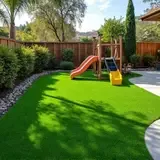
Boise Artificial Turf Playground Turf
A playground surface is bought for one number - the fall height it is rated to - and everything else about the installation serves that number.
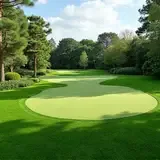
Boise Artificial Turf Putting Greens
A backyard putting green is a shaped base with a surface stretched over it, and the published specification starts with the speed number the surface has to deliver.
Boise Artificial Turf Commercial Turf
Commercial turf is published as a high-traffic, high-drainage surface, and the two numbers that decide whether it works are the annual hours it is rated for and how fast the base sheds water.
Areas we serve
Boise
Artificial Turf in Boise, ID - costs, water and soil notes.
Meridian
Artificial Turf in Meridian, ID - costs, water and soil notes.
Nampa
Artificial Turf in Nampa, ID - costs, water and soil notes.
Caldwell
Artificial Turf in Caldwell, ID - costs, water and soil notes.
Eagle
Artificial Turf in Eagle, ID - costs, water and soil notes.
Kuna
Artificial Turf in Kuna, ID - costs, water and soil notes.
Star
Artificial Turf in Star, ID - costs, water and soil notes.