A residential lawn is judged on looks and wear. A putting green is judged on how the ball rolls, and a playground surface on what happens when a child falls on it. Three products, three specs — and it is the two specialty builds where the specification is published and measurable. Both still sit on the same engineered base as any other turf yard in Boise, ID.
Two Specialty Builds, Two Standards
The performance criteria do not overlap. A green has to hold a roll: the surface is measured on a stimp meter and the base under it is shaped to produce breaks. A playground has to absorb a fall: the surface is rated to a test standard for impact attenuation, and every material in it has to be non-toxic because children sit and crawl on it. What both inherit is the base.
Putting Greens: a Stimp Rating and a Shaped Base
A custom backyard green is a short list of measurable features:
- A tour-grade nylon surface with a stimp meter rating of 9-11, the published roll standard.
- Multiple cups with adjustable pin positions.
- A fringe of longer turf for chipping, a second product at a second cut height.
- A sand trap that is a real sand bunker, not a painted shape: excavation and a defined edge.
- Undulation with breaks built into the surface, which is why the base must be shaped, not merely levelled.
Lifespan is unchanged: a properly built green sits in the same 15-20 year band, with brushing and infill top-ups.
Playground Turf: Rated to a Fall Height
Playground turf replaces the aesthetic specification with a safety one.
- ASTM F1292 fall-rated, protecting up to a 10-foot fall height — compare it with your equipment's highest playable point.
- Non-toxic — no lead, no heavy metals: a material list, not a marketing adjective.
- Stay-cool technology that reflects heat, because the surface is used barefoot in full afternoon sun.
- ADA accessible as a wheelchair-friendly surface — firm, level and continuous.
The commercial version adds high-traffic surfacing rated for 5,000+ hours of annual use, ADA-compliant fall zones, and drainage engineered for 30+ inches per hour for spring melt and heavy rain.
What Both Builds Share With Any Turf Yard
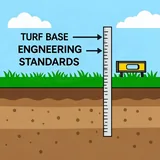
The base is where the published engineering numbers live:
- Washed #57 crushed stone or CA7 clean angular gravel, open-graded, with roughly 40% open void space.
- A minimum 4-inch excavation for heavy use, up to 6 inches in heavy clay.
- Compaction to 95% Standard Proctor density in damp 2-inch lifts, with a one to two percent fall away from structures.
- A non-woven geotextile at the bottom of the excavation as a soil separator, with the compacted base finishing 1.5 inches below the top of the edging.
- 1.33 tons of aggregate per 100 sq ft, plus a 10% compaction buffer.
None of that changes because the surface is a green or a play area.
What to Ask Before Either Build
| Ask | What a specific answer sounds like |
|---|---|
| Roll rating of the putting surface? | A tour-grade nylon surface with a stimp meter rating of 9-11 |
| Fall height the play surface is rated to? | ASTM F1292 fall-rated, protecting up to a 10-foot fall height |
| Material safety, heat and access? | Non-toxic — no lead, no heavy metals; stay-cool technology; ADA accessible with compliant fall zones |
| Product spec and base scope in writing? | Face weight in ounces per square yard, pile height, backing layers, UV stabilisers; aggregate type, excavation depth, compaction target, slope and geotextile placement |
Ask for the spec sheets, not a sample: a sample shows a colour, the spec sheet shows how the surface behaves after two summers.
Where These Two Builds Go Wrong
Both fail in the same two places, and neither is about the surface product.
The base. Address poor drainage, unstable soil and structural concerns before the surface goes down: a shaped green or level play area cannot be corrected from above once it is secured. The breaks on a green are built into the base, and a fall zone that is not flat is a safety issue.
The perimeter. Lifting seams and curling edges are installation issues — inadequate adhesive or base preparation — and the most common reason a new specialty surface looks old early. Edging set so the base finishes 1.5 inches below the top keeps it reading as one continuous surface.
The third failure is the wrong product: a play surface without a fall rating, or a green specified on appearance rather than a stimp rating, cannot be corrected without lifting the surface.
Where a Match Comes In
Specialty builds attract specialist quotes, and the useful comparison is the specification behind the total. This site is an independent matching service, not a provider: we do not employ contractors, we do not sell turf, and we do not build, inspect or guarantee the work.
The service is free. Describe the project — the green's shape, the play surface's fall height, the access and the shade — and receive up to 3 matches from id-licensed local pros within one business day. No commissions, no markup, no obligation.
Frequently asked questions
What makes a putting green different from normal turf?
The surface and the base. A proper green uses a tour-grade nylon surface with a stimp meter rating of 9-11, multiple cups with adjustable pins, a fringe for chipping, a real sand bunker and undulation with breaks built in, so the base is shaped rather than levelled.
How safe is artificial turf in a playground?
Published playground turf is ASTM F1292 fall-rated and protects up to a 10-foot fall height, is non-toxic with no lead and no heavy metals, uses stay-cool technology, and is ADA accessible as a wheelchair-friendly surface.
Do putting greens and playgrounds need the same base as a lawn?
Yes. Both need open-graded washed angular stone with roughly 40% void space, a minimum 4-inch excavation, compaction to 95% Standard Proctor in damp 2-inch lifts, a geotextile at the bottom of the excavation and a one to two percent fall away from structures.
How long do specialty turf surfaces last?
A properly built green or playground sits in the same 15-20 year band as any other quality installation, with maintenance. Manufacturers typically warrant the material 8 to 15 years, and the installer warrants workmanship for 1 to 5 years.
Sources
- Boise Artificial Turf Pros — putting green installation page (stimp 9-11 surface and green features)
- Boise Artificial Turf Pros — playground turf page (ASTM F1292 fall rating, non-toxic, stay-cool, ADA)
- Boise Artificial Turf Pros — commercial turf page (high-traffic rating, fall zones, storm drainage)
- Boise Artificial Turf Pros — turf base engineering standards and sub-base checklist
Related
Artificial Turf services in Boise
Boise Artificial Turf Residential Turf
A residential turf installation is a drainage and sub-base project that ends in a lawn, and the published numbers only make sense once you know which of the two you are paying for.

Boise Artificial Turf Pet Turf
Pet turf is judged by what happens underneath it, not by how the blades look, and the published specification is a deeper, fully draining base plus an infill that changes the chemistry of the yard.
Boise Artificial Turf Playground Turf
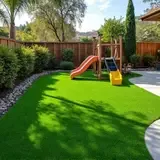
A playground surface is bought for one number - the fall height it is rated to - and everything else about the installation serves that number.
Boise Artificial Turf Putting Greens
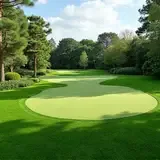
A backyard putting green is a shaped base with a surface stretched over it, and the published specification starts with the speed number the surface has to deliver.
Boise Artificial Turf Commercial Turf
Commercial turf is published as a high-traffic, high-drainage surface, and the two numbers that decide whether it works are the annual hours it is rated for and how fast the base sheds water.
Areas we serve
Boise
Artificial Turf in Boise, ID - costs, water and soil notes.
Meridian
Artificial Turf in Meridian, ID - costs, water and soil notes.
Nampa
Artificial Turf in Nampa, ID - costs, water and soil notes.
Caldwell
Artificial Turf in Caldwell, ID - costs, water and soil notes.
Eagle
Artificial Turf in Eagle, ID - costs, water and soil notes.
Kuna
Artificial Turf in Kuna, ID - costs, water and soil notes.
Star
Artificial Turf in Star, ID - costs, water and soil notes.